Air Con
このサイトはアフィリエイト広告を利用しています。 This site uses affiliate advertising.
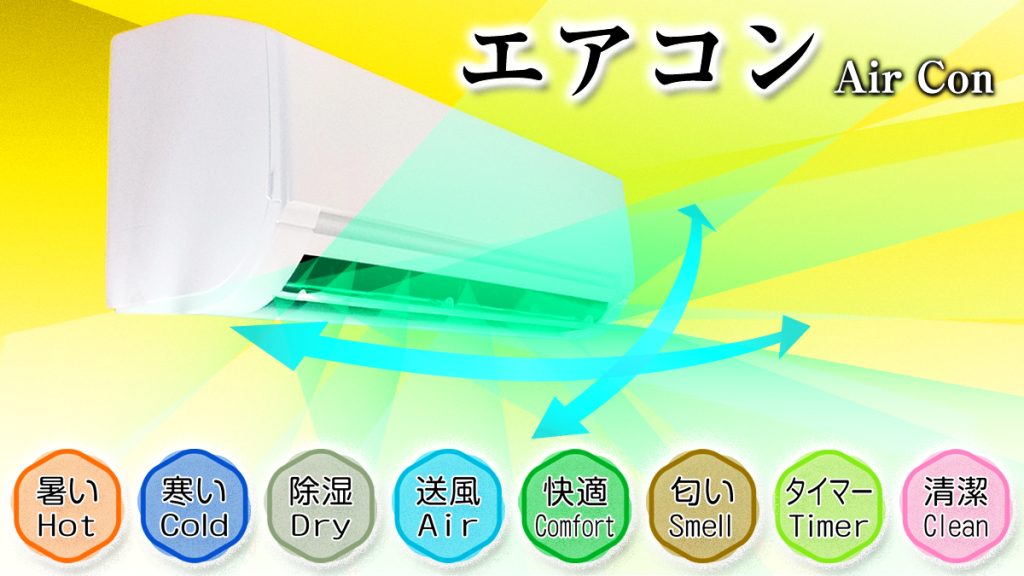
Air Con ~ エアコン (空調機)~
Air conditioners are abbreviated as “air conditioner” in Japan and “Air Con” in English.
Anyway (‘ω’)
I feel like it’s getting hotter every year in Japan.
It seems that temperatures are rising not only in Japan but all over the world due to global warming and climate change. The air conditioner in my room is old and although it got through this summer, it was hot again this year in Japan and I was worried about when it would break down and stop working.
I’ve been hesitant to replace it because to me it’s one of the most expensive things I own after my house and car, and it’s not completely broken.
However, over the past two or three years, the noise from the air conditioner’s outdoor unit has gotten louder, and when I use the heating in the winter, it becomes so loud that it roars for a while.People overseas say that Japan is quiet, but the noise from my outdoor unit has gotten to the point where I’m receiving complaints, so I decided to buy a new one.
Japanese car manufacturers are world famous, but there are also many manufacturers that handle air conditioners, so I would like to introduce how I decide and purchase for those who are interested, those who are considering replacing their current car, those who are interested in Japanese air conditioners, and foreigners living in Japan.
How to Choose an Air Conditioner
My points for buying:△=I don’t really care、〇=It would be better if it was included、◎=Required △・〇・◎will be taken into consideration.
Japanese Manufacturers:◎
They are made with the Japanese climate in mind, the heat and humidity in the summer and the cold and dryness in the winter, and when I think about warranties, I buy products made by Japanese manufacturers.
Major Japanese air conditioner manufacturers (in alphabetical order)
Corona(コロナ) https://www.corona.co.jp/ [GLOBAL]https://www.corona.co.jp/en/index.html Fully equipped with cleaning functions. Energy-saving and comfortable air conditioner, etc. DAIKIN(ダイキン) https://www.daikin.co.jp/ [GLOBAL]https://www.daikin.com/ Air conditioning, etc., characterized by air circulation and comfortable humidity control FUJITSU GENERAL(富士通ゼネラル) https://www.fujitsu-general.com/jp/ [GLOBAL]https://www.fujitsu-general.com/ Even hidden mold bacteria in air conditioners! Mold-resistant series, etc. HITACHI(日立) https://www.hitachi.co.jp/ [GLOBAL]https://www.hitachi.com/ ”Freeze cleaning” removes dust and oil stains from air conditioners and other items that are difficult to get dirty. Mitsubishi Electric(三菱電機) https://www.mitsubishielectric.co.jp/ [GLOBAL]https://www.mitsubishielectric.com/en/index.html Air conditioning tailored to each individual for comfort for everyone MITSUBISHI HEAVY INDUSTRIES(三菱重工) https://www.mhi.com/jp [GLOBAL]https://www.mhi.com/ Beaver air conditioners are packed with cutting-edge technology. Panasonic(パナソニック) https://panasonic.jp/ [GLOBAL]https://holdings.panasonic/global/gateway.html Air conditioners that focus on cleanliness with “Nanoe X” and internal clean operation SHARP(シャープ株式会社) https://corporate.jp.sharp/ [GLOBAL]https://global.sharp/ Combating air risks: Energy saving, air conditioners, etc. TOSHIBA(東芝) https://www.global.toshiba/jp/top.html [GLOBAL]https://www.global.toshiba/ww/top.html What’s important is great energy savings, clean air, comfortable air conditioning, air conditioners, etc. There are also other original products from manufacturers and shops. Where to buy them is also important.(;^ω^)
Price: ◎ (the cheaper the better)
(See Japan’s Electronics Retailers Sales Rankings for 2023) 1.ヤマダ電機(ヤマダホールディングス):YAMADA HOLDINGS 2.ビックカメラ:BicCamera 3.ケーズデンキ(ケーズホールディングス):K’S HOLDINGS CORPORATION 4.エディオン:EDION Corporation 5.ヨドバシカメラ:Yodobashi Camera 6.ノジマ:Nojima 7.ジョーシン:Joshin 8.コジマ:Kojima You can also buy it online, or at your local electronics store, but I wanted to see the real thing (mass retailers have life-size dummies), and I’ll check the installation fee and pickup of the old air conditioner before I buy it.
Check the number of tatami mats (room size) that the air conditioner can be used in: ◎
Japanese air conditioners give a rough guide for the size of the room they are to be used in, measured in tatami mats, but this varies slightly depending on the manufacturer, so please check. This is just a guideline, as the effectiveness of the air conditioner will vary depending on the structure of the room (wooden or concrete) and whether the room is exposed to the sun.
1畳=About 1.8㎡、6畳:9㎡~10㎡、8畳:13㎡、10畳:16㎡~17㎡、12畳:19㎡~20㎡、14畳:22㎡~23㎡、18畳:29㎡
I live in the suburbs, so in Japan, a room is large enough for 10 to 12 tatami mats,
and it doesn’t work well in a 6 or 8 tatami mat room, so the price is inevitably higher, so price is also important.
Air conditioner compatible tatami mats: price range
6 tatami mats: around 80,000 yen
8 to 10 tatami mats: around 100,000 yen
12 to 14 tatami mats: around 130,000 yen
18-23 tatami mats: 100,000-260,000 yen
26 tatami mats or more: 170,000 to 400,000 yen
Also, the higher the heating/cooling capacity, the higher the price tends to be,
and if you need new products or additional features, the price can be high.
The cost of installing an air conditioner varies depending on the contractor, but it is estimated to cost between 13,500 and 17,000 yen for a new one and between 12,000 and 16,000 yen for a used one. (As of September 2024)
Check heating and cooling capacity: ◎
Air conditioning and heating are essential. I live in Saitama Prefecture, where it’s hot in the summer and cold in the winter. [*Separate personal research]
Energy saving performance:〇
Since I’m single and dependent on my parents, I don’t really care about it, but I think people with larger families should be more concerned.
Automatic filter cleaning function:〇
I like to do my own cleaning before the season starts, so I don’t really care about the automatic cleaning function.
Air Purification Function:△
I don’t really care, but these days most air conditioners from all manufacturers come with them as standard.
Sensors and sensing functions:△
It would be nice if it was there, but I don’t really care.
Dehumidification and humidification functions:〇
I would like a dehumidifier, but I don’t need a humidifier.
Ventilation function:△
Since the room is on the second floor, it is always ventilated so it is not necessary. It may be a good idea for those who have difficulty ventilating.
Timer:〇
I would use it if it was available, but even if I set it to turn on when I wake up, I wake up when it starts, so I don’t use it much. In the summer, I leave it on while I sleep, and in the winter, I turn it off before I go to sleep and turn it on when I wake up, so it’s not that important to me.
Smartphone connectivity:△
I often go out with the window open, so even if it did exist, I don’t think I would use it. This may be useful for people who live alone and keep their windows closed.
Save Settings:〇
In my house, the breaker doesn’t trip when I use the air conditioner in each room in the summer, but in the winter when I use the heater in each room, the breaker sometimes trips, so I’d like to use a save setting that reduces the amount of power used.However, because the maximum capacity during operation is reduced, it may take a little longer for the room to heat up.
Installation location of indoor and outdoor units:〇
Indoor unit:I’m going to install it in the same place it’s always been installed, so it’s not a problem.However, please make sure there is a dedicated outlet for the air conditioner near where you will be installing the air conditioner. If there is not one nearby, please refrain from extending the outlet using a power strip or other means, as this may exceed the rated capacity of the wiring equipment and result in additional charges due to heat generation. Location of outdoor unit:I can put it on the balcony without any problems, but you might want to be careful in the summer as it will be exposed to direct sunlight.
Availability of dedicated outlets and voltage:◎
*This is very important! If you are purchasing a new air conditioner, be sure to check the shape of the outlet. If the shape of the plug for the air conditioner you are purchasing is different from the shape of the outlet for the air conditioner in the room you are using, you will not be able to insert the plug, and you will not be able to use the air conditioner you have just purchased. Please purchase an air conditioner that fits the shape of the outlet, as this will require conversion work for the outlet, which will be an extra expense. For rooms with a size of 10 to 12 tatami mats, the outlets will be either 100V or 200V depending on the manufacturer and model, and air conditioner outlets are divided into four types: ① single-phase 100V 15A, ② single-phase 100V 20A, ③ single-phase 200V 15A, and ④ single-phase 200V 20A.
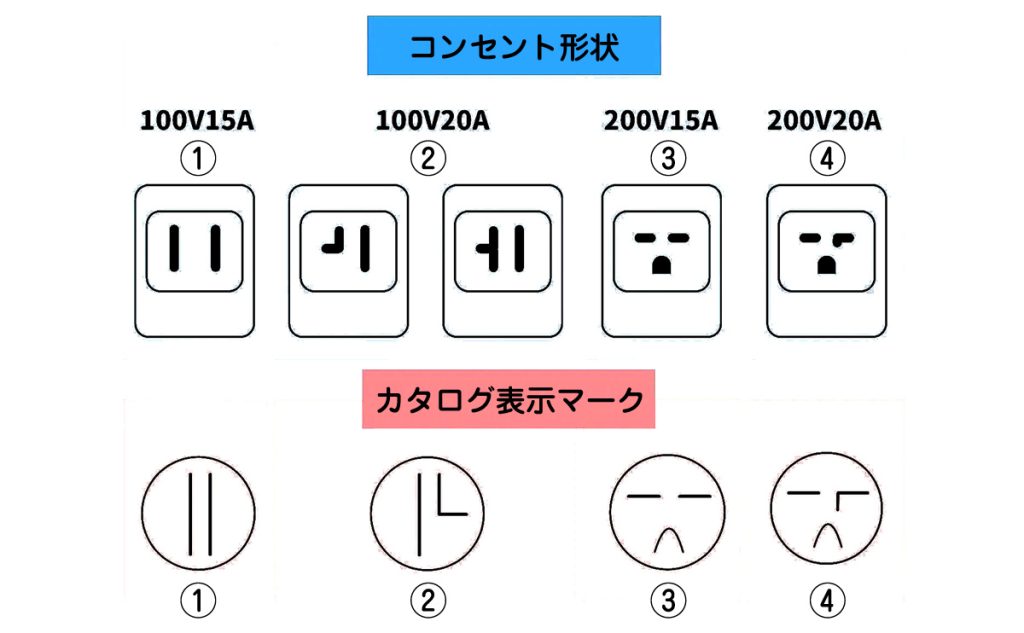
This “single-phase” refers to the method of transmitting electricity to household appliances. ①Single-phase 100V 15A is called the parallel type and is mainly used in air conditioners for rooms of 6 to 8 tatami mats. ②Single-phase 100V 20A is called the IL type and is mainly used in air conditioners for rooms of 10 to 12 tatami mats. ③Single-phase 200V 15A is called the tandem type and is mainly used for air conditioners for rooms larger than 14 tatami mats. ④The single-phase 200V 20A type is called the Elber type and is mainly used in air conditioners for rooms larger than 16 tatami mats. The larger the room, the more voltage and current is required. The above sizes for 〇 to 〇 tatami mats vary slightly depending on the manufacturer, so it is best to check. If you have a problem with your AC, such as not having a dedicated outlet or needing to change the voltage because it is different from the AC’s voltage, please consult with an electrician or a plumber when purchasing your AC.
Breaker Amperage:◎
When installing an air conditioner, a breaker of 30A or more is generally required. The amperes required to operate an air conditioner vary depending on the model and operation. The breaker’s amperage is marked on the breaker. The required ampere capacity also varies depending on the number of people in your household, your lifestyle, the season, and the types of electrical appliances you use. The ampere capacity is as follows: For 1-2 people: 30A, for 2-3 people: 40A, for 4 or more people: 50-60A. If the maximum current draw of the air conditioner is high or if other electrical appliances are used at the same time, the breaker may trip. In that case, it would be a good idea to use the save settings if they are available. The save setting limits the maximum current during operation. *For details, please contact the power company or electrician in your area.
Air conditioner replacement and recycling:◎
I was thinking about buying an appliance recycling ticket to buy the air conditioner I was using and taking it in myself, but I got tired of thinking about it so I decided to have the store take it when I bought a new air conditioner. I will list it below as information.
[Have it taken away when you buy an air conditioner]If you purchase a new air conditioner at a home appliance store, you can have the store take your old air conditioner away. You will have to pay recycling fees and collection and transportation fees, but you can easily replace your old air conditioner with a new one. [Bring it to your local recycling center] You can also take the air conditioner to a recycling center designated by your local government. In this case, you will need to remove the air conditioner yourself and purchase a home appliance recycling ticket. Although this can cut removal and recovery costs, amateurs should be careful when removing the air conditioner carelessly, as there is a risk of damage or accidents. [Request a designated home appliance recycling center] You can dispose of your air conditioner by contacting a designated home appliance recycling center. The contractor varies depending on the municipality, so be sure to check in advance. To dispose of an air conditioner, you are required to pay a home appliance recycling fee. Most recycling fees for general home air conditioners are 990 yen (tax included) or 2,000 yen (tax included) (as of September 2024). [Ask an air conditioner buyer] In Japan「エアコン買取」If you search for it, you will find a lot of information, such as free air conditioner appraisals and sending it in for appraisal, but I don’t know because neither I nor anyone I know has had their air conditioner appraised and purchased. If it’s a new and popular model, it might be a good idea to have it purchased.
※About warranty:◎
Manufacturer warranties and extended warranties are available. Manufacturer warranties are usually one year, with refrigerant systems generally lasting around five years. Some retailers may also offer additional warranty services such as extended warranties. I take warranties very seriously.In the past, I had an experience where an air conditioner from a famous Japanese manufacturer broke within two years. I spoke to an electronics store, and no matter what manufacturer it is, there are hits and misses, and it will also depend on how you use it, so I think a warranty is a must. Also, the outdoor unit is always outside, and there have been times when it stopped turning. I did some research to see if I could buy them separately, but I recommend buying the indoor and outdoor units of an air conditioner as a set, since they work closely together. Most manufacturers also sell them as sets.
This is getting quite long.(;^ω^)、If money were no object, I would buy the top model from my favorite manufacturer.I don’t live near the sea, so I don’t need a “salt-resistant” air conditioner. I don’t live in an area where the minimum temperature drops below -10°C, so I didn’t choose the “cold climate” option. If I live in an area where the minimum temperature drops below -10℃, I would buy a cold climate version. Air conditioners for cold regions have strong heating capacities and are designed to protect against frost, snow, and freezing.
While I was thinking about the above, about 2-3 years passed.(;´・ω・)、In the past, it completely broke and stopped working in the summer, but this time I made up my mind to buy a new one at the nearby Kojima Electric before it broke.Air conditioner before replacement:Purchased in 2012

I had forgotten when I bought it, but it served me well for 12 years! It soothed me when I was hot or cold! Thank you for enduring Japan’s harsh summer of 2024 before it stops completely!
And this air conditioner:Purchased in October 2024(*’ω’*)
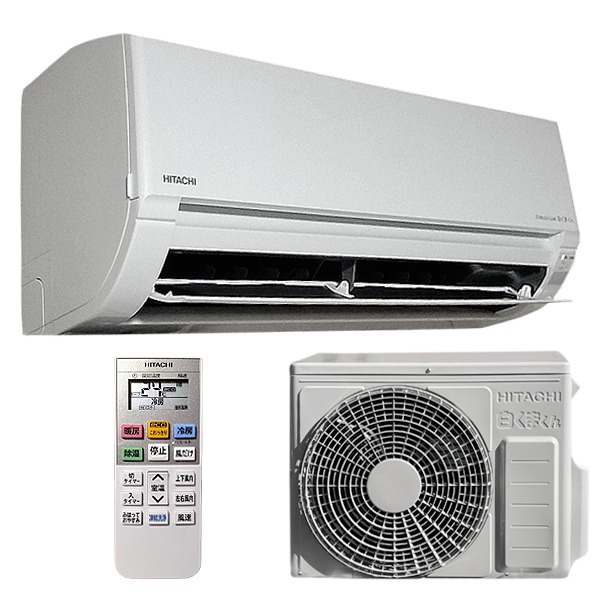
`Shirokuma kun’ makes his debut!This is a lower model"Automatic airflow direction [up/down and left/right] is possible. Until now, I had to manually change the direction of the airflow from left to right, so even when I was working on the computer the airflow would go up and down, so it felt like I was constantly being hit by the air conditioner when I used it, but now that the left and right directions move automatically, I don’t feel like I’m constantly being hit by the air. And the price when choosing an air conditioner:◎(The cheaper the better) I had set out criteria for making a decision, and as far as I could see online, there were various price ranges, but the price was the unit price + installation work + removal of the old air conditioner + recycling fee + 10-year warranty. コジマ(Kojima)I purchased it from the electrician at a price I was happy with. I’m sure there are other places where you can buy it cheaper, and there are probably some retailers that offer better conditions, but in Japan, prices are likely to continue to rise, and even if I tried to replace it in the middle of the cold winter when it stopped working, there’s no guarantee that the installation work would be done right away, so I’m glad I bought it after summer ended when I wouldn’t be using it as much.
A few days have passed since the installation was completed, but it has been really hot this year, and we are still using the air conditioner even in October.
(I am sensitive to heat.(;´・ω・))
Warranty Information:◎、It comes with a 10-year warranty (although the warranty terms change from 1 year, 5 years, or 10 years), and I plan to take good care of it for those 10 years.
I posted this in the hope that it will be of some help to people who are thinking about buying an air conditioner or who are interested in Japanese air conditioners. However, since the information in this post is current as of early October 2024, I would ask that you please double-check with each air conditioner manufacturer or electrical store.
For those coming to Japan from overseas、The above figure「Outlet Shape」Outlets in①Single-phase 100V 15A parallel type is the mainstream in Japan, so if you want to use your own household electrical appliances in Japan, it’s a good idea to bring a Japanese conversion plug. The same goes for those traveling abroad from Japan.
Thank you for watching.