
Goshuin Stamp
このサイトはアフィリエイト広告を利用しています。 This site uses affiliate advertising.

2025年 4月 右:埼玉県越谷市の久伊豆神社、左:埼玉県埼玉県久喜市 鷲宮神社 御朱印
Goshuin Stamp – ゴシュイン (御朱印) –
table of contents
- The goshuin stamp I received
- Appropriate attire for visiting shrines and temples
- Proof of worship
- Goshuincho (stamp book)
- others
- Goshuincho bag
- Goshuincho cover
The goshuin stamp I received
| Saitama(埼玉) Washinomiya Shrine Hisaizujinja Koshigaya | Tokyo(東京) Sensoji Temple Asakusa Jinja |
| Tochigi(栃木) Nogi Shrine |
It seems to be secretly popular among people from overseas to collect them when they visit Japan.
I also started a website to introduce Japan, so I thought I would try collecting goshuin myself.
Recently, my friends have also started collecting goshuin stamps to encourage each other.
From now on, it will be an encouragement for me to go to various places, and it will be a good proof that I went there, so I think I need a goshuin book first.(I didn’t even know about the existence of the stamp book.)(;´・ω・)。
As I have stated on my homepage, I am an atheist and do not believe in any religion.
However, as a Japanese person, when I visit shrines and temples, I somehow feel at peace.
This may be because of the peaceful atmosphere, as the buildings and plants are cared for to be preserved in their original location and passed on to future generations.
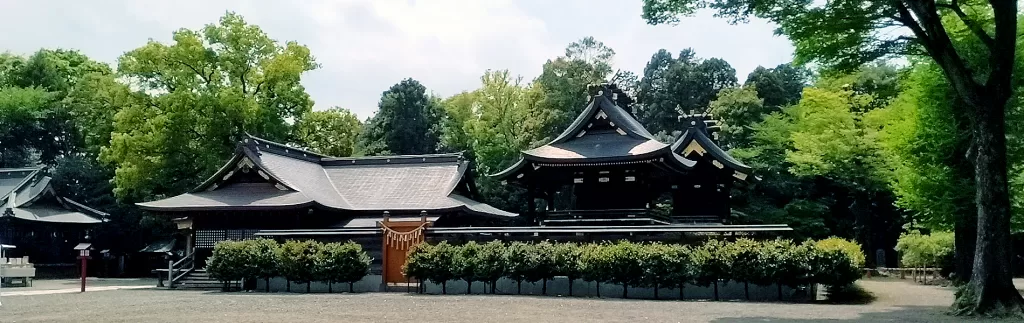
2025年4月 埼玉県埼玉県久喜市 鷲宮神社
I often travel by car and drop in whenever I come across a place, but this time I looked up goshuin and didn’t even know that goshuincho existed.(;^ω^)
Until now, I used to wear shorts and sandals during the summer when visiting shrines and temples, but I realized that this was not a good idea.
Appropriate attire for visiting shrines and temples
Appropriate attire for men visiting shrines
・Shirts with collars (dress shirts and polo shirts)・Long pants (slacks or formal chinos)
・Shoes (shoes without heels are not allowed)
Appropriate attire for women visiting shrines
・one piece・Long skirt
・Long pants (slacks or formal chinos)
・Shoes (shoes without heels are not allowed)
The above guidelines are recommended to avoid revealing skin or overly casual clothing, but you don’t need to be so strict about it, and the most important thing is your feelings. I read this on various shrine websites, so I changed from sandals to shoes before praying.
Since it has been hot recently (April 2025), I visited Washinomiya Shrine in Saitama Prefecture wearing a t-shirt, casual pants, and running shoes.
By chance, a young priest or chief priest was standing in front of me, and as we passed each other he said “こんにちは(Kon’nichiwa = Hello)” to me in a very calm voice, with a smile or not. I replied “こんにちは(Kon’nichiwa = Hello)” to him cheerfully, so I assumed he accepted me.(*’ω’*)
The important thing is not to make a fuss, even if you get emotional.
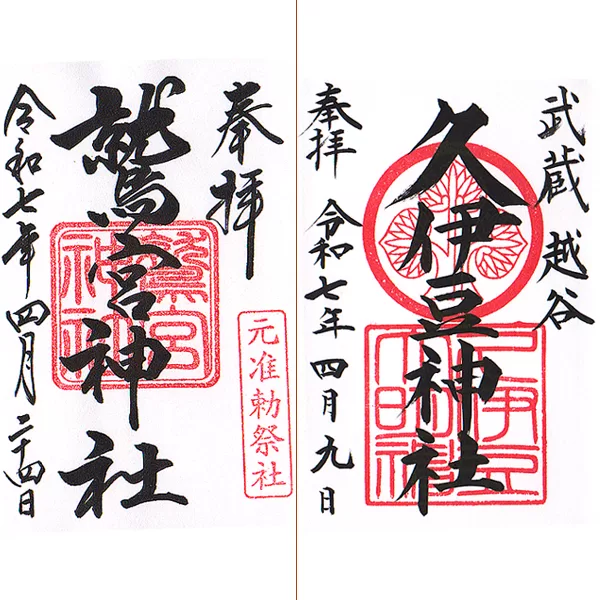
A goshuin is a seal or ink inscription given to a shrine or temple as proof of visiting. It often contains the date of the visit and the name of the shrine or temple, and it is common to collect them as a record in a special goshuin book.
Proof of worship
Goshuin stamps are given as proof that you have visited a shrine or temple.
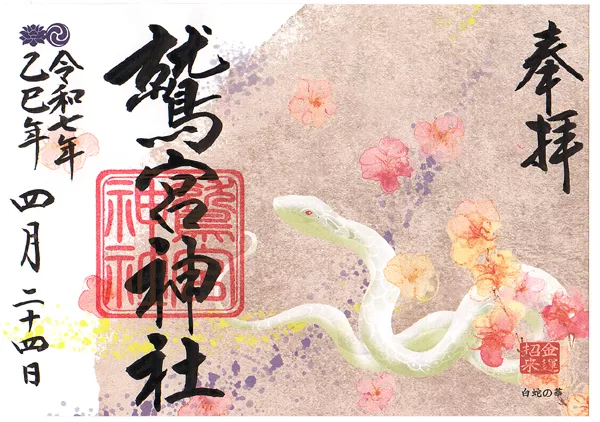
Seals and ink
It typically features a vermilion seal and the name of the shrine or temple, as well as the date of the visit, written in ink.
I received a “White Snake Flower Goshuin (double page)” (about 1,000 yen) at Washinomiya Shrine in Kuki City, Saitama Prefecture, but I was asked to have it written separately in my “Goshuin book.”
The goshuincho is not handwritten directly. I was told that I could either display it or stick it in my goshuincho, so I decided to stick it in my goshuincho.
Goshuin book

It is common to collect goshuin in a special goshuin book.
Goshuincho can be purchased at shrine or temple gift shops or stationery stores.
I found out that I could purchase a goshuincho (stamp book) for around 1,500 yen at Hisaizu Shrine (the main shrine of Koshigaya) in Koshigaya City, Saitama Prefecture, which is close to where I live, so I bought one.
This is a one-of-a-kind goshuin stamp notebook based on Fujinokuizu Shrine, which was donated by paper cutting artist Ishii Kazuomi, and it is a well-made goshuin stamp notebook.
The origin of goshuin
It is believed to date back mainly to the Nara and Heian periods (approximately 710-794 AD), and its roots can be found in the “certificates of receipt for sutra submission” that were issued when copied sutras were submitted to shrines and temples.
I learned that in recent years, collecting goshuin stamps has become a popular hobby, with many temples and shrines now offering goshuin stamps of various designs, and that they are collected by both Japanese and foreigners.
Manners
You can get a goshuin at the shrine or temple office or gift shop after praying.
(I received it before the visit without knowing it.)(;´・ω・)。
At shrines, it is common to receive them at the “gift center” or “shrine office,” and it is considered good etiquette to open the goshuin book beforehand and hold both hands when handing it over, but when I wanted one written, I asked a lot of questions, saying, “I’ve just started, so I don’t really know what to do.”
The cost of a goshuin stamp varies depending on the temple or shrine, but is usually between 300 and 500 yen (as of 2025).
Please remember that goshuin are a proof of your visit and are not meant to be collected.
However, when you look at them again, the kanji and layout are really cool.
As I’ve gotten older, I feel like I’ve come to understand once again that Japanese design sense has a mysterious charm.
others
It is also recommended to have separate goshuincho (stamp books) for shrines and temples.
I was trying to share(・□・;)!
Because the goshuin are handwritten, each one has its own unique personality.
I truly believe this, so I would like to introduce a variety of goshuin stamps to you.
Collecting temple stamps helps me deepen my connection with the gods and Buddhas and gives me an opportunity to look back on my memories of visiting the temples, so I believe it will be a step forward for me.
Goshuin is a cultural tradition enjoyed by many people as proof of visiting a shrine or temple.
Collecting goshuin stamps can be a good way to learn about Japanese culture and the history of temples, shrines, and Buddhist temples. Even if you know absolutely nothing about it like me, I think if you can absorb new information with respect, it can be a little bit of encouragement in your life.
I wondered if I should write my name in the goshuincho, but when I looked it up, I found out it’s fine either way.
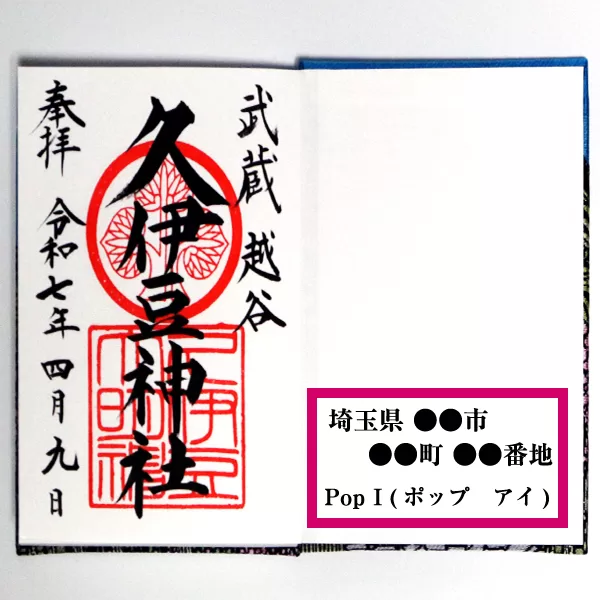
At famous shrines and temples with many worshippers, there is a possibility that the goshuincho may get mixed up, so some people say it’s safer to write your name on it, and I wrote mine in because I was worried I might accidentally drop it! And the address too!
Apparently some people write directly on the white area on the back of the cover or stick stickers on it.
In Japan, when lost items are returned, they are deified overseas, but I don’t think there is a 100% chance that they will be returned.
However, if it’s a goshuincho, I don’t think I’d be using one that someone else has already used, so maybe I’ll get it back.(*’ω’*)
It is also said that when making a request at a shrine, it is best to say the address in your heart.
As I have said many times before, I am an atheist and do not believe in any religion, but if I wander around a shrine or other place for free, I think it is good to show respect for the place and be respectful of the culture, so I do so.
Goshuincho bag(ごしゅいんちょうぶくろ)
Then, when I was looking around to get a goshuin, I saw some older women taking out goshuin books from their drawstring bags, so I immediately went to the 100 yen shop to look for a drawstring bag…(._.)
I couldn’t find anything that fit my needs so I searched on Amazon and purchased this.
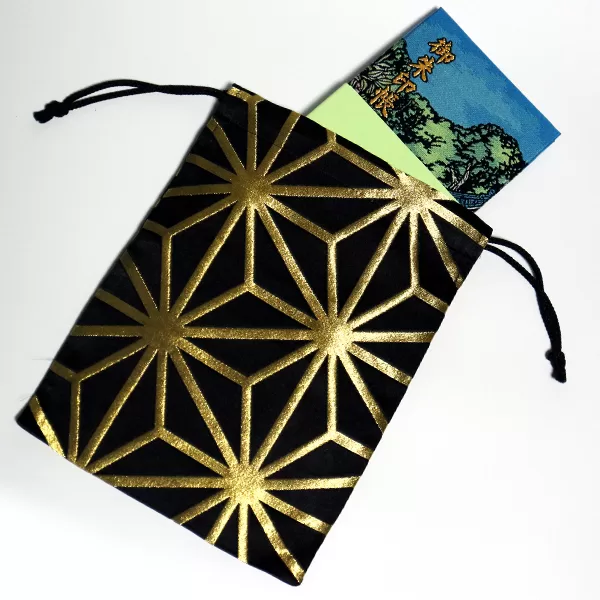
It’s made in Sukumo, Kochi Prefecture, using Japanese Nishijin fabric, and I really like how solidly it’s made.
There were many other nice Japanese patterns available, so if I can no longer use the drawstring bag, I think I’ll buy something from this shop again.
Brand: マシュール:MOITIE MOITIE is apparently run by Mathieu Co., Ltd., a company that plans, manufactures and sells textile products.
Goshuincho cover
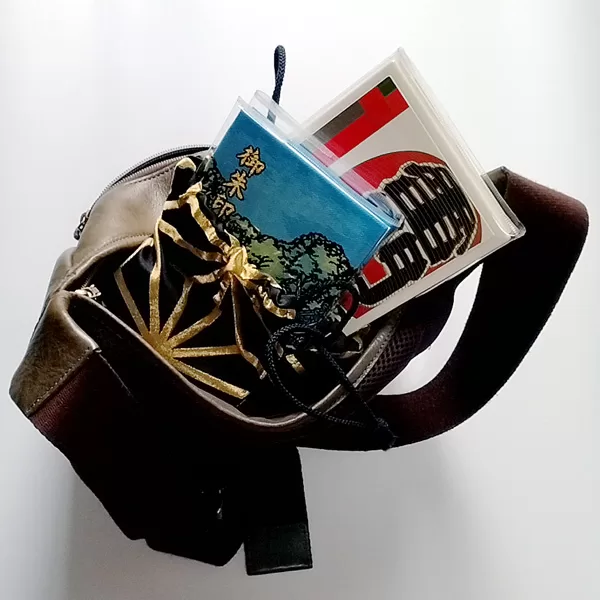
I’m a rough(;^ω^)
I started collecting goshuin stamps, but I always end up treating them roughly, so I looked into whether there were any covers for them.
(‘ω’)It’s quite common.
I don’t intend to brag to anyone, but I put a cover on my goshuincho because I wanted to keep it as proof that I visited the shrine.
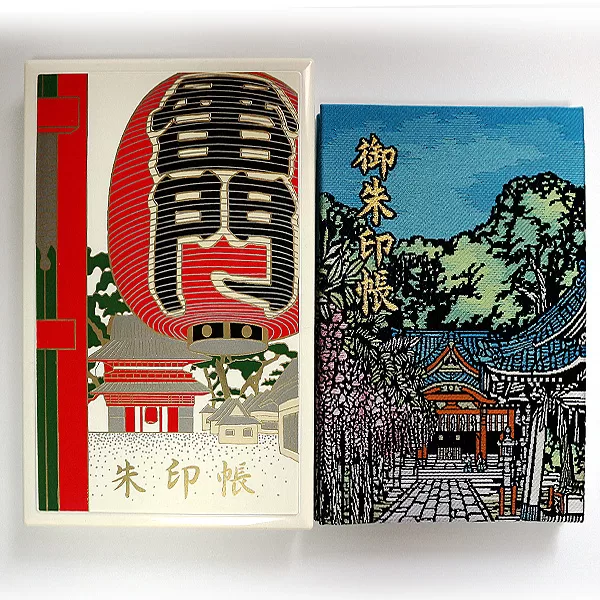
The size of the goshuincho varies depending on the book.
I prepared a goshuincho (stamp book) for both shrines and temples, but I didn’t realize they were so different in size.
(;´・ω・)
Left: Sensoji Temple(蒔絵御朱印帳 「白」)
Right: Koshigaya Hisaizu Shrine(藤の御朱印帳)
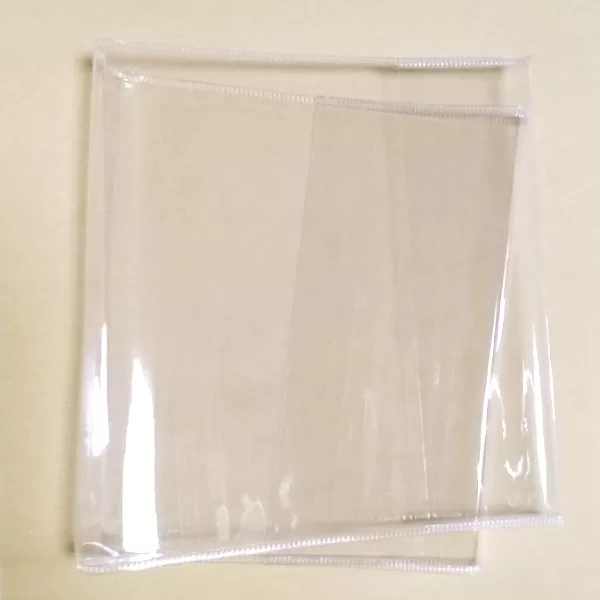
Adjust to the size of your goshuincho.
The size of the goshuincho above.
Left: Sensoji Temple(蒔絵御朱印帳 「白」)
Goshuincho size: approx. 18cm x approx. 12cm
Right: Koshigaya Hisaizu Shrine(藤の御朱印帳)
Goshuincho size: approx. 16cm x approx. 11cm
I bought the clear ones.
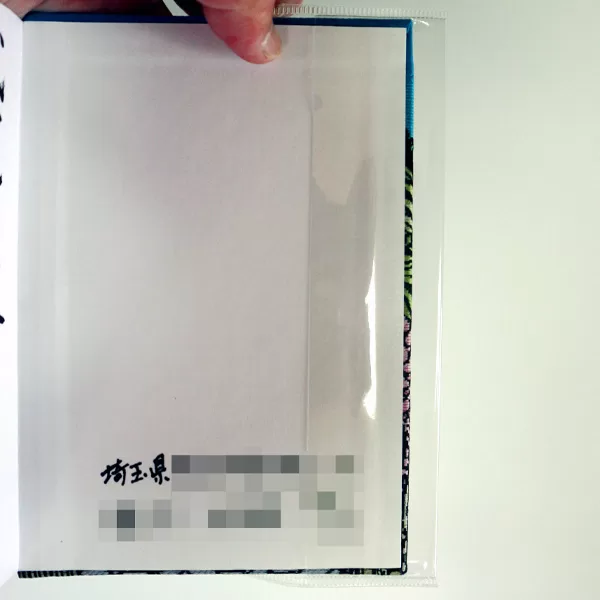
Insert one side of the cover.
I looked at reviews on Amazon and other sources, but depending on the thickness, it may be difficult to insert it into the cover.
My Koshigaya Hisaizu Shrine (wisteria goshuincho) fits perfectly in the cover, which is about 16cm x 11cm.
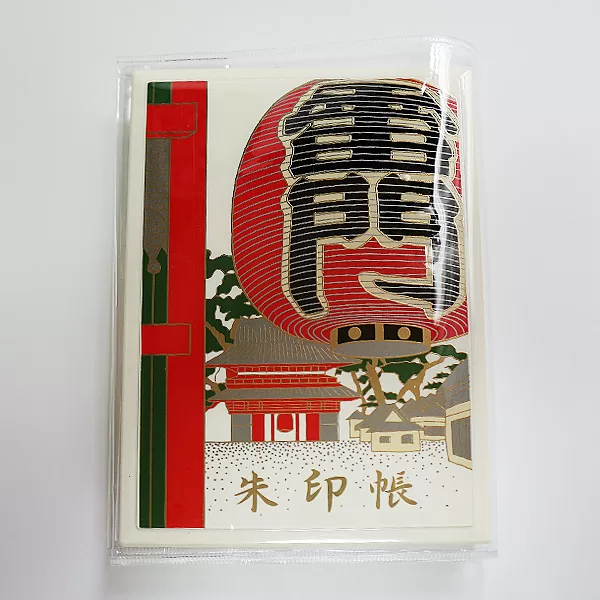
Sensoji Temple Cover(蒔絵御朱印帳 「白」)
I purchased a cover for my goshuincho (stamp book) that was approximately 18cm x 12cm, and although there was a little room left, I am very happy with it.
(*’ω’*)I’m not the type of person who is very dependent on material things, but I feel like something in me has been empowered by self-satisfaction.
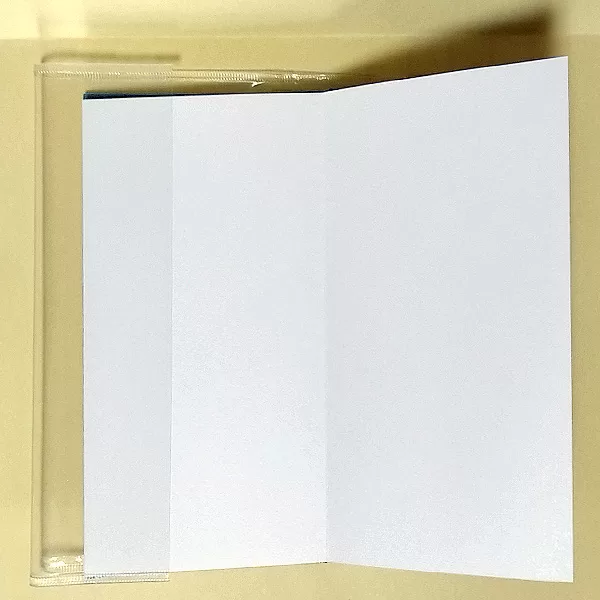
Folding side
The folded side is not bound into a pouch so that it fits the goshuincho.
The open state is the normal state, and you can insert pages for the next time, etc.
I would like to continue visiting various shrines, temples, etc. and introducing them to you.
Thank you for watching.